Google – From a Garage Project to the World’s Information Engine
“To organize the world’s information and make it universally accessible and useful.” – Google Mission Statement
Long before Google became a verb, a browser's homepage, an internet companion, and in effect the portal to the web, it was conceived as a research project by two inquisitive graduate students: Larry Page and Sergey Brin at Stanford University in the 1990s.
The internet was growing fast, but searching for information was chaotic. Early search engines ranked pages based on keyword repetition — leading to spammy, unreliable results. Larry Page had a different idea. He believed websites should be ranked by importance, based on how many other pages linked to them — like academic citations. Sergey Brin helped turn that idea into code.
Their program, initially named Backrub, evaluated links to sort a webpage's credibility and usefulness. Shortly, it was obvious that this was more than a piece of software — it was the beginning of how humans would search for knowledge.
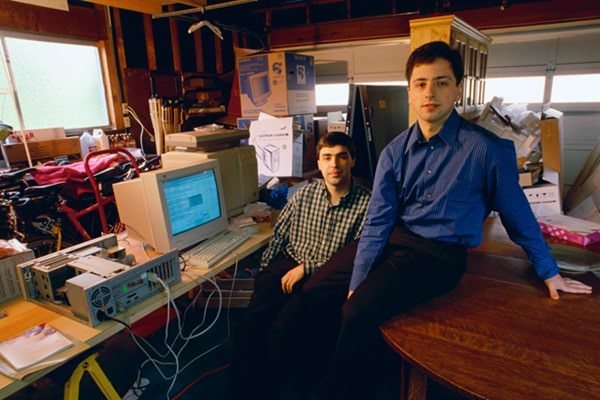
Larry Page & Sergey Brin in early days
In 1998, with scarce capital and limitless vision, Larry and Sergey leased a modest garage in Menlo Park. That garage was where Google was born.
Google's white homepage, when other search engines were filled with ads and news banners, felt new. It wasn't loud. It wasn't flashy. It just worked.
As more users used it, Google got better — making search smarter, faster, and more intuitive. Rather than requiring people to learn the internet, Google learned from people. This simplicity and usefulness philosophy guided the company's every next move.

The original Menlo Park garage office
From Gmail, Maps, and YouTube, to Android and Chrome, every product shared one idea:
Make life simpler.
But expansion came with a price. As Google emerged as one of the globe's most powerful companies, it experienced new demands on privacy, ethics, content regulation, and the effects of technology on human life. The company now continues to adapt, walking the tightrope between innovation and accountability.
Google is no longer merely a search engine — it has become a worldwide infrastructure of knowledge, communication, and applications that millions use daily.
What We Can Learn from Google’s Story
1. The Biggest Ideas Solve the Biggest Problems
Google wasn't founded to be profitable — it was founded to solve an actual problem: how to find reliable information. When your idea truly benefits people, growth comes easily, not artificially.
2. Simplicity is a Superpower
While others added features and distractions, Google added clarity. The minimalist search bar became a classic. Sometimes the best design is the one that steps out of the way.
3. Innovation Flourishes in Curiosity, Not Certainty
Larry and Sergey didn't begin with a business plan — they began with questions. Curiosity sparks discovery. When you remain curious, you remain receptive to breakthrough concepts.
4. Think Long-Term, Act Today
Google evolves to keep up with the way the world speaks. Continuously evolving — without losing direction — is how brands remain ageless.
5. Success Involves Evolution
From a garage to cloud computing and artificial intelligence, Google expands through evolution. The moral of the story? Reinvention is not an answer to change — it is the plan.
Google’s journey shows how two students, a garage, and a bold idea reshaped how humanity interacts with knowledge. It is a story of curiosity, vision, and relentless innovation.
In a world full of information, Google teaches us that organizing chaos can change the world.


Comments
Post a Comment